
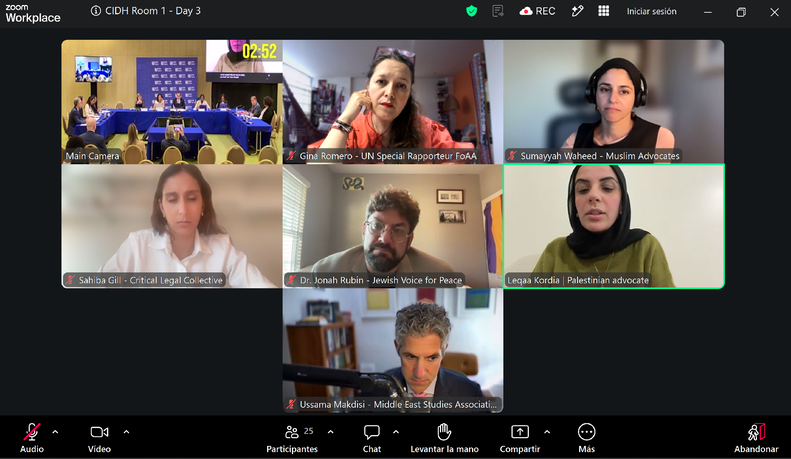
At the public hearing on freedom of expression and academic freedom in the US, the Special Rapporteur laid out how surveillance, securitization and sanctions are silencing campus debate, and urged the government to review its standards on peaceful protest.
The Special Rapporteur’s statement on academic freedom
Good afternoon everyone. I am pleased to be here with you today.
I have been doing a close follow up on hundreds of allegations concerning violations of the rights to freedom of peaceful assembly and of association within university settings worldwide—predominantly related to encampments, protests, and demonstrations connected to the pro-Palestine movement. I have observed and reported a sharp deterioration in the freedoms of expression, peaceful assembly, and association, alongside significant erosion of academic freedom across several countries worldwide, and in the United States.
In relation to the US, I have met directly with students who organized or participated in peaceful on-campus protests, as well as with faculty members and administrative staff. Within this, I have engaged directly with more than 100 students across at least nine universities in the United States.
In October 2024 I produced an informal document on the crackdown of assembly and association rights in universities, and a set of recommendations for academic institutions. What I found reflected on what was happening in US universities, and I am only going to list these trends as the prior interventions also mention some of them:
- Although the pro-Palestine solidarity movement on campuses were largely peaceful, participants faced concerted attacks across multiple fronts.
- Campus regulations were altered frequently, arbitrarily, and without transparency which deprived students of foreseeable rules.
- Universities actively facilitated, requested, and endorsed law enforcement interventions to disperse peaceful demonstrations. Riot police, bomb squads, and counterterrorism units were deployed against low-intensity gatherings, resulting in excessive, disproportionate force.
- Campuses experienced a marked expansion of surveillance mechanisms which were carried out without basic transparency regarding data collection, retention, or sharing practices.
- Academic institutions imposed harsh and disproportionate sanctions, including suspensions, expulsions, and withholding degrees.
- Disciplinary measures and enforcement actions disproportionately targeted international students, student leaders, and specific minority groups. And affected their formal and informal associations that also faced persecution.
- A continuous line of influence emerged between public authorities and university leadership compromising institutional autonomy, effectively turning funding into a bargaining chip to drive the suppression of fundamental rights and freedoms.
During 2024 and 2025 several letters were sent concerning some of these trends, as well as arrest, detention and the threat of deportation of students, in at least 10 University campuses, including Columbia University, New York University in Manhattan, Yale University, University of Southern California, Emerson College, in Boston, Washington University in St. Louis, Texas University in Austin, Massachusetts Institute of Technology and Harvard University, among others. This underscore that these were not isolated incidents, but rather indicative of a broader, systemic trend. Only one letter was responded by the US government.
Follow-up reviews confirm that the consequences for affected individuals, their families, and broader academic communities remain profound, including deep mental health harm. And, sadly, two years on, these troubling trends have not abated; rather, their impacts have substantially deepened:
- I have witnessed a radical shift in campus access and physical security. Beyond forcing members of the academic community to undergo continuous ID checks, securitization closed off university grounds. By transforming once-open spaces into secured perimeters, institutions have curtailed the broad exchange of ideas and excluded outside voices that traditionally foster intellectual diversity.
- Pervasive surveillance across campuses is alarming. Several universities have adopted biometric and facial recognition tools to monitor students and faculty. Such surveillance inflicts profound harm on the exercise of fundamental freedoms. It generates a powerful chilling effect, fractures community trust, and imposes a severe psychological toll on young people—undermining mental health, classroom academic performance, and peer connections.
- Having visited several U.S. universities both last year and this year, the shift in atmosphere is palpable. Prolonged security deployments, intrusive monitoring, and the persistent fear of reprisals for engaging in basic activism or political debate have fostered widespread self-censorship. Campuses have grown eerily quiet; dissent has been suppressed, particularly in institutions where regulations were altered arbitrarily without adequate notice. Crucially, this suppression is no longer confined to pro-Palestine advocacy—it has expanded across the board, stifling open debate on unrelated social and political issues.
Education plays a key role in civic and political formation by developing awareness of democratic values, respect for political pluralism, tolerance and critical thinking. High schools and universities in some contexts remain the primary avenues for youth mobilization and public participation, shaping political discourse, social and cultural identities and the future sustainability of democracy and human rights. All what had happened, poses a profound threat to democratic systems and institutions, especially when young people are affected. It risks alienating an entire generation, damaging their participation and perception of their role in democratic processes.
Therefore, when we talk about academic freedoms and the rights to freedom of expression, assembly, association and participation, we are always talking about rule of law democracy and its sustainability. All of these are being lost with the attacks we have seen and have been included in this hearing.
And, what is happening in universities, is a clear portrait of the health of the country, as the decline of academic freedom has become a constituent predictor of democratic backsliding.
I stand ready if the commission wants to advance in a joint visit to the country, and in participating in any other of the events requested by the civil society.
I urge the government to: review the standards of peaceful protests, including the need to respect the disruptive characteristic of protests, and the analysis on what constitute violence, as well as the review the report by Irene Khan, former UN Special Rapporteur freedom of opinion and expression, that questions the antisemitism definition used by governments as the US and analysis the impact of its use in free speech and other freedoms.
To end I need to indicate that this participation was to provide an informal, unsworn, oral briefing in the present public hearing. This briefing was provided on a strictly voluntary basis and without prejudice to the privileges and immunities of the United Nations, its officials, and experts on mission. Nothing herein shall be construed as an express or implied waiver of such privileges and immunities, which are hereby expressly reserved.
Thanks.